Measuring engine oil is one of those basic car skills that sounds simple, but doing it wrong can give misleading results and lead to serious engine problems. I learned this the hard way.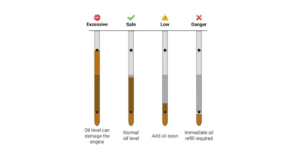 Years ago, I checked my oil in a rush, on uneven ground, right after shutting the engine off. The dipstick showed “full,” so I ignored it. A week later, I heardan engine ticking. Turns out the oil was actually below the minimum the entire time.
That small mistake taught me a big lesson: How you measure engine oil matters just as much as how often you check it. In this in-depth, high-readability guide, you’ll learn:
- What measuring engine oil actually means
- The correct step-by-step process
- When and how often to measure oil
- How to read a dipstick properly
- Oil color and level comparison table
- Common mistakes to avoid
- Buyer’s guide for oil and tools
- FAQs every driver asks
Whether you drive a daily commuter like the Toyota Corolla or a turbocharged sedan like the Honda Accord, this guide applies to you.
What Does “Measuring Engine Oil” Really Mean?
Measuring engine oil means checking both:
- Oil level (how much oil is in the engine)
- Oil condition (color, thickness, contamination)
A correct oil measurement tells you:
- If your engine is properly lubricated
- If oil needs topping up
- If oil needs changing
- If there may be a deeper engine problem
It’s not just about seeing oil on the dipstick; it’s about reading it correctly.
Why Measuring Engine Oil Is So Important
Engine oil performs several critical tasks:
- Lubricates moving parts
- Reduces friction and wear
- Helps cool the engine
- Cleans internal components
- Prevents corrosion
If oil is too low, too dirty, or too old, engines, even reliable ones like the Hyundai Elantra, can suffer long-term damage. Measuring oil regularly helps you catch problems before they become expensive repairs.
When Is the Best Time to Measure Engine Oil?
Timing matters more than most people realize.
Best conditions to measure oil:
- Vehicle parked on level ground
- The engine is warm, but turned off
- Wait 10–15 minutes after driving
This allows oil to drain back into the oil pan for an accurate reading. Avoid measuring:
- Right after turning the engine off
- On slopes or uneven ground
- With a cold engine (unless the manufacturer says otherwise)
How Often Should You Measure Engine Oil?
Here’s a practical rule of thumb:
- Once a month
- Before long trips
- After oil changes
- If warning lights appear
- If the engine sounds different
Even modern vehicles like the Mazda CX-5 benefit from manual oil checks, despite electronic monitoring systems.
How To Measure Engine Oil (Step-by-Step)
Let’s break this down into a clear, beginner-friendly process.
Step 1: Park on Level Ground
This ensures oil settles evenly inside the oil pan. Uneven ground = inaccurate readings.
Step 2: Turn Off the Engine and Wait
Turn the engine off and wait 10–15 minutes. Hot oil moves around quickly. Waiting allows it to settle.
Step 3: Open the Hood
Pull the hood release lever (usually under the dashboard). Secure the hood using the prop rod or struts.
Step 4: Locate the Oil Dipstick
The dipstick usually has:
- Yellow or orange handle
- Ring or loop design
In most vehicles, like the Ford Focus, it’s clearly marked with an oil symbol.
Step 5: Remove the Dipstick
Pull it out completely. You’ll see oil on it, but don’t read it yet.
Step 6: Wipe the Dipstick Clean
Use:
- Clean rag
- Paper towel
This removes oil splashed during engine operation.
Step 7: Reinsert the Dipstick Fully
Push it all the way back in until it seats properly. Partial insertion = false reading.
Step 8: Pull It Out Again and Measure
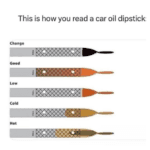
Now read the oil level. Look for:
- Two dots
- Two lines
- “MIN” and “MAX” markings
Oil should fall between the minimum and maximum marks.
Understanding Dipstick Markings
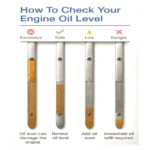
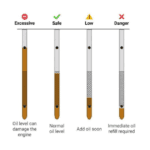
Here’s what the markings mean:
| Dipstick Reading | Oil Level Status | What To Do |
| Above MAX | Overfilled | Drain excess oil |
| At MAX | Perfect | No action |
| Mid-range | Safe | Monitor |
| Near MIN | Low | Add oil soon |
| Below MIN | Critically low | Add oil immediately |
Measuring Oil Condition (Color & Texture)
Oil condition is just as important as oil level.
| Oil Appearance | Meaning | Action |
| Amber / Light Brown | Fresh oil | OK |
| Dark Brown | Used oil | Normal |
| Black | Old oil | Change soon |
| Milky / Frothy | Coolant contamination | Stop driving |
| Thick / Gritty | Dirty oil | Change immediately |
Milky oil is a serious warning sign often linked to head gasket issues.
How Much Oil Should You Add If It’s Low?
Add oil slowly.
- Add ¼ quart (or ~250 ml) at a time
- Wait 1–2 minutes
- Recheck the dipstick
Overfilling can cause:
- Oil foaming
- Seal damage
- Increased pressure
- Reduced engine performance
Even premium engines like those in the BMW 3 Series are vulnerable to overfilling damage.
Common Mistakes When Measuring Engine Oil
Avoid these common errors:
- Measuring on uneven ground
- Not wiping the dipstick before reading
- Measuring immediately after driving
- Overfilling oil
- Confusing the transmission dipstick with the oil dipstick
- Ignoring oil color
Most oil-related engine problems start with small mistakes.
Comparison Table: Correct vs Incorrect Oil Measurement
| Factor | Correct Method | Incorrect Method |
| Engine Temp | Warm, rested | Hot or cold |
| Ground | Level | Sloped |
| Dipstick | Cleaned first | Dirty |
| Reading | Between marks | Guessing |
| Oil Added | Small amounts | Overfilled |
Can You Measure Engine Oil Without a Dipstick?
Some newer vehicles use electronic oil level sensors instead of dipsticks. Luxury cars like certain versions of the Mercedes-Benz C-Class require checking oil through the infotainment system.
Typical process:
- Turn the ignition on
- Access vehicle menu
- Select oil level
However, dipsticks remain more reliable for visual inspection.
Buyer’s Guide: Tools & Oil for Accurate Measurement
1. Clean Rags or Paper Towels
Essential for wiping the dipstick.
2. Correct Engine Oil Type
Check the owner’s manual for:
- Viscosity (e.g., 5W-30, 0W-20)
- Oil type (synthetic, conventional)
3. Funnel
Prevents spills when adding oil.
4. Quality Engine Oil Brands
Reliable options include:
- Mobil 1
- Castrol
- Valvoline
- Shell
Cheap oil may degrade faster and affect readings.
How Measuring Oil Helps Prevent Engine Damage
Regular oil measurement helps detect:
- Oil leaks
- Oil burning
- Worn piston rings
- Valve seal problems
- Cooling system issues
Catching these early can save thousands in repairs.
Personal Experience: Why I Measure Oil Monthly
After that early mistake, I made oil measurement a monthly habit.
Five minutes.
No tools.
No cost.
It has helped me:
- Catch a slow oil leak early
- Improve fuel economy
- Avoid engine noise
- Drive with confidence
It’s one of the simplest habits with the biggest payoff.
Read More: What Is A Car Muffler
FAQs: How To Measure Engine Oil
1. Should I measure engine oil hot or cold?
A warm engine, turned off for 10–15 minutes, is best.
2. Can I measure oil right after driving?
No. Oil needs time to settle.
3. How low is too low?
Below the minimum mark is dangerously low.
4. Why does my oil level keep dropping?
Possible leaks, burning oil, or worn engine components.
5. Can overfilling oil damage my engine?
Yes. Overfilling can cause pressure and seal damage.
6. Does oil color always mean it’s bad?
Dark oil is normal. Milky or gritty oil is not.
7. Do new cars still need oil measurement?
Yes. Even modern engines rely on proper oil levels.
8. How long does measuring oil take?
Less than five minutes.
Final Thoughts: Measuring Engine Oil Is a Skill Every Driver Should Have
Measuring engine oil isn’t complicated, but doing it correctly makes all the difference.
It protects:
- Your engine
- Your fuel economy
- Your wallet
From compact cars like the Toyota Corolla to luxury vehicles like the Mercedes-Benz C-Class, the process is simple and universal. Make it a habit. Five minutes today can save thousands tomorrow.