Checking your car’s engine oil might sound basic, almost too basic to worry about. But here’s the truth from someone who has owned everything from older high-mileage sedans to newer turbocharged vehicles: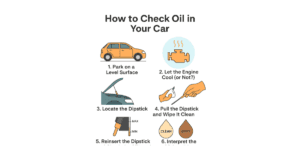 👉 Most engine damage I’ve seen could have been prevented by a simple oil check. It takes five minutes. It requires zero mechanical experience. And it can literally save you thousands of dollars.
In this guide, I’ll walk you through:
- Exactly how to check oil in your car
- The difference between dipstick and electronic systems
- Common mistakes people make
- What your oil color really means
- When to add oil (and how much)
- A practical buyer’s guide for oil-related tools
- Frequently asked questions
This is written in a casual, real-world tone like advice from someone who’s done this dozens of times in their driveway.
Let’s get started.
Why Checking Engine Oil Is So Important
Engine oil is your car’s lifeblood. It:
- Lubricates moving engine parts
- Reduces friction and heat
- Cleans debris and sludge
- Protects against corrosion
- Helps maintain fuel efficiency
Without proper oil levels, your engine can:
- Overheat
- Develop knocking sounds
- Lose power
- Completely seize
And once an engine seizes? That’s often game over.
How To Check Oil In Your Car (Step-by-Step Guide)
Here’s the proper method, whether you’re a first-time driver or just need a refresher.
Step 1: Park on Level Ground
Make sure your car is parked on flat, even ground. This ensures accurate oil readings.
Step 2: Turn Off the Engine
Wait about 5–10 minutes after turning off the engine. This allows oil to drain back into the oil pan.
⚠️ Checking too soon can give you a false low reading.
Step 3: Open the Hood
Find the hood release lever (usually under the dashboard). Lift the hood and secure it with the hood prop or hydraulic supports.
Step 4: Locate the Dipstick
The oil dipstick usually has:
- A bright yellow, orange, or red handle
- A small loop or tab
It’s typically labeled with an oil symbol.
Step 5: Pull Out and Wipe Clean
Remove the dipstick and wipe it completely clean with:
- A paper towel
- A clean rag
This removes oil splash and gives you an accurate reading.
Step 6: Reinsert Fully
Push the dipstick all the way back in.
Step 7: Pull It Out Again and Read It
Now check:
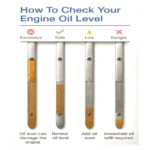
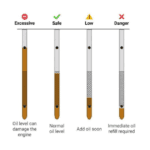
- Oil level between MIN and MAX marks
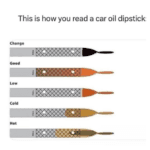
- Oil color and texture
If oil is:
- Between marks → You’re good.
- Below MIN → Add oil.
- Above MAX → Too much oil (this is bad, too).
What Should Engine Oil Look Like?
Here’s what I’ve personally observed across different vehicles:
| Oil Appearance | What It Means | Action Needed |
| Light amber/golden | Fresh, healthy oil | No action |
| Medium brown | Normal used oil | Monitor |
| Dark brown/black | Old but typical | Change soon |
| Milky/creamy | Coolant contamination | Immediate mechanic visit |
| Gritty/metallic | Internal wear | Urgent inspection |
Fresh oil in gasoline cars turns dark quickly, so color alone isn’t always a problem. Texture and level matter more.
How To Check Oil in Cars Without a Dipstick
Many modern cars (BMW, Mercedes, newer Audi models) use electronic oil level monitoring systems.
Here’s how:
- Turn the ignition to accessory mode or start the car.
- Access the vehicle menu.
- Navigate to “Oil Level” or “Vehicle Status.”
- Wait for the measurement.
Important notes:
- The car must be warm.
- Vehicle must be on level ground.
- The engine usually must be idling.
Check your owner’s manual for exact steps.
Common Mistakes When Checking Oil
After years of seeing people do this wrong, here are the biggest mistakes:
❌ Checking on an incline
Gives inaccurate readings.
❌ Not wiping the dipstick first
You’ll read splash oil, not the actual level.
❌ Overfilling
Too much oil causes:
- Foaming
- Pressure buildup
- Seal damage
❌ Ignoring low oil warning lights
If that light comes on, don’t “wait until the weekend.”
When Should You Check Your Oil?
Here’s my personal rule:
- Every 1,000 miles
- Before long road trips
- After an oil change (to confirm level)
- If you notice engine noise
- If the oil warning light flickers
High-mileage engines burn oil faster. Turbocharged engines also tend to consume more oil.
How Much Oil Should You Add?
If your oil is below the minimum:
- Add half a quart at a time
- Wait 1–2 minutes
- Recheck dipstick
Never dump a full quart blindly. Most vehicles hold 4–6 quarts total, but always verify in your owner’s manual.
Buyer’s Guide: What You Need to Check and Maintain Engine Oil
You don’t need much, but having the right tools makes it cleaner and easier.
1. Microfiber Shop Rags
- Reusable
- Better than paper towels
- Less lint
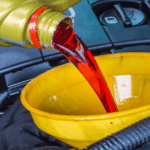
2. Funnel
- Prevents spills
- Especially helpful for tight engine bays
3. Correct Engine Oil Type
Check:
- Viscosity (5W-30, 0W-20, etc.)
- Synthetic vs conventional
- Manufacturer specification
4. Disposable Gloves
Optional, but saves cleanup time.
5. Oil Catch Pan (For DIY Changes)
If you plan to change oil yourself.
Conventional vs Synthetic Oil (Quick Comparison)
| Feature | Conventional Oil | Synthetic Oil |
| Cost | Lower | Higher |
| Protection | Moderate | Superior |
| Longevity | 3,000–5,000 miles | 7,500–10,000+ miles |
| Cold Performance | Average | Excellent |
| Best For | Older engines | Modern engines |
Personally? I run full synthetic in anything built after 2025.
What Happens If You Don’t Check Your Oil?
Real consequences I’ve seen:
- Burned piston rings
- Timing chain wear
- Turbo failure
- Complete engine seizure
And once damage starts, oil won’t fix it. Oil neglect is one of the most expensive avoidable mistakes in car ownership.
Signs Your Oil Might Be Low (Without Checking)
- Engine ticking sound
- The oil pressure light is flickering
- Burning smell
- Blue exhaust smoke
- Rough idle
If you notice any of these, check immediately.
How Long Does It Take?
Checking oil properly takes:
🕒 3 to 5 minutes.
That’s it. It’s one of the highest ROI maintenance habits you can develop.
Personal Experience: Why I Check Monthly
I once had a high-mileage sedan that started consuming oil around 120,000 miles. If I hadn’t checked monthly, it would’ve run dry between oil changes.
Instead, I simply topped it off every few weeks and drove it another 60,000 miles. That five-minute habit extended the engine’s life.
Read More: How To Test BMW Oil Level Sensor
FAQs: How Do You Check Oil In Your Car
1. Should I check the oil hot or cold?
Best practice:
- Warm engine
- Turn off
- Wait 5–10 minutes
2. Can I check the oil in the morning before driving?
Yes, cold readings are fine as long as the car is on level ground.
3. What if oil is slightly above max?
Slightly above is usually fine. Well above? Have some drained.
4. How often should oil be changed?
Depends on oil type:
- Conventional: 3,000–5,000 miles
- Synthetic: 7,500–10,000 miles
Always follow manufacturer recommendations.
5. Is dark oil always bad?
Not necessarily. Modern detergents darken oil quickly.
6. Why is my car burning oil?
Common causes:
- Worn piston rings
- Valve seals
- Turbo issues
- High mileage wear
7. Can low oil cause the check engine light?
Yes, but usually the oil pressure light appears first.
8. What does milky oil mean?
Coolant mixing with oil may cause a head gasket to fail.
9. Can I drive with low oil?
Short distance only if necessary, but risky.
10. Does checking oil too often hurt anything?
Not at all. It’s smart maintenance.
Final Thoughts
If you remember only one thing from this article, let it be this: Checking your oil is the simplest way to protect your engine.
It costs nothing.
It takes minutes.
It prevents catastrophic failure.
Whether you drive a brand-new SUV or a 15-year-old commuter car, make oil checks a habit. Your engine and your wallet will thank you.