I’ll be honest, I didn’t check my engine oil regularly when I first started driving. I assumed oil changes were enough. Then one day, my dashboard warning light flickered. It wasn’t dramatic. No smoke. No loud bang.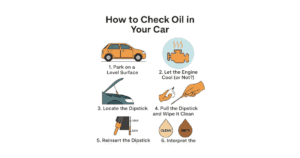 Just a small red oil symbol staring at me like it knew something I didn’t. That moment taught me something important: Checking your car’s oil takes five minutes, but skipping it can cost thousands.
Since then, checking oil has become part of my routine. It’s simple, fast, and gives peace of mind. In this complete guide, I’ll walk you through:
- How to check oil using a dipstick
- How to check oil in cars without a dipstick
- What the oil level and color mean
- Common mistakes
- Tools you need
- Oil types comparison
- A buyer’s guide
- Real-world tips from experience
- FAQs
Let’s get started.
Why Checking Engine Oil Is So Important
Your engine oil does four major jobs:
- Lubricates moving parts
- Reduces friction
- Cool internal components
- Cleans sludge and debris
Without proper oil level or quality, engine parts grind against each other. That’s how engines fail. Modern engines, whether in a Toyota, Honda, BMW, or Ford,d rely heavily on clean oil to function efficiently.
How To Check Oil With a Dipstick (Most Cars)
This is the most common method.
Step 1: Park on Level Ground
Make sure the car is on flat ground. Oil reading won’t be accurate on a slope.
Step 2: Turn Off the Engine
Wait at least 5–10 minutes after shutting off the engine. This allows oil to settle.
Step 3: Open the Hood
Use the hood release lever inside the car.
Step 4: Locate the Dipstick
Usually marked with a bright yellow or orange handle.
Step 5: Pull It Out & Wipe It Clean
Use a clean cloth or paper towel.
Step 6: Insert It Back Fully
Push it all the way in.
Step 7: Pull It Out Again & Check Level
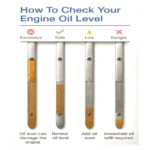
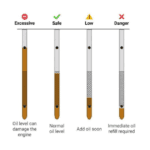
You’ll see two marks:
- MIN (Low)
- MAX (Full)
Oil should be between these marks. If below MIN, you need to add oil.
How To Check Oil Without a Dipstick (Modern Cars)
Some newer vehicles (especially luxury brands like BMW and Mercedes-Benz) use electronic oil level sensors.
Steps:
- Turn ignition ON (engine running or accessory mode depending on model)
- Navigate to vehicle settings on dashboard s,creen
- Select “Oil Level”
- Wait for system reading
These systems use internal sensors instead of manual dip to read. Personal opinion? I still prefer dipsticks. They’re simple and reliable.
What Oil Level Should Look Like
Perfect Level:
Between MIN and M, AX ideally slightly below MAX.
Too Low:
Below MIN, add oil immediately.
Too High:
Above MAX can cause pressure issues.
What Oil Color Means
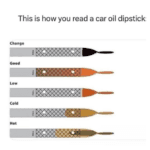
| Oil Color | Meaning |
| Amber / Light Brown | Fresh oil |
| Dark Brown | Used but normal |
| Black | Time for change |
| Milky | Possible coolant leak |
| Gritty | Contamination |
Dark oil doesn’t always mean bad, but thick sludge is a warning sign.
Comparison Table: Dipstick vs Electronic Oil Monitoring
| Feature | Dipstick Method | Electronic Sensor Method |
| Accuracy | Very reliable | Usually accurate |
| Ease of Use | Manual check | Digital display |
| Speed | 3–5 minutes | 1–2 minutes |
| Failure Risk | Very low | The sensor can fail |
| Cost of Repair | Cheap | Expensive if faulty |
| Best For | DIY owners | Modern luxury cars |
When Should You Check Engine Oil?
From experience, here’s what works best:
- Once a month
- Before long road trips
- Ifthe oil warning light appears
- After the oil change
- If the engine sounds louder than usual
Signs Your Oil Might Be Low
- Oil warning light
- Ticking or knocking sound
- Burning smell
- Engine overheating
- Poor fuel efficiency
Ignoring these signs can lead to serious engine damage.
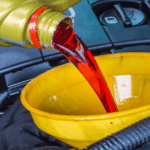
How To Add Oil If It’s Low
- Locate oil filler cap (labeled “Engine Oil”)
- Remove cap
- Use funnel
- Add small amount (half quart/liter at a time)
- Wait 1 minute
- Recheck a dipstick
Never overfill.
Buyer’s Guide: Choosing the Right Engine Oil
Choosing oil can feel overwhelming. Let’s simplify.
1. Check Owner’s Manual
Your vehicle manufacturer recommends a specific viscosity, such as:
- 5W-30
- 0W-20
- 10W-40
Always follow the manufacturer’s recommendation.
2. Types of Engine Oil
| Type | Best For | Pros | Cons |
| Conventional | Older engines | Affordable | Shorter lifespan |
| Synthetic Blend | Balanced use | Better protection | Mid-priced |
| Full Synthetic | Modern engines | Best performance | More expensive |
| High Mileage | 75k+ miles | Reduces leaks | Slightly thicker |
I personally switched to full synthetic after 60,000 miles engine felt smoother.
3. Climate Matters
Hot climate → Slightly thicker oil may perform better
Cold climate → Lower “W” rating (like 0W-20) flows better
Common Oil Checking Mistakes
- Checking immediately after turning off the engine
- Checking on uneven ground
- Not wiping the dipstick first
- Confusing transmission dipstick
- Overfilling oil
Yes, overfilling is just as bad as running low.
How Often Should You Change Oil?
General rule:
- Conventional: Every 3,000–5,000 miles
- Synthetic: Every 7,000–10,000 miles
But always follow manufacturer guidelines.
Real Personal Experience
When I once ignored checking oil for 3 months, I discovered it was almost at MIN. No warning light. No strange noise. Just slowly decreasing.
That taught me: Don’t rely only on dashboard warnings. Manual checking prevents surprises.
Advanced Insight: Why Oil Level Drops
Oil consumption can happen due to:
- Normal engine burn-off
- Worn piston rings
- Valve seal leaks
- Turbocharged engines use more oil
Some brands naturally consume more oil, especially high-performance engines.
What Happens If You Don’t Check Oil?
Worst-case scenarios:
- Engine seizure
- Spun bearings
- Blown head gasket
- Complete engine replacement
Cost?
$3,000 – $7,000+
Oil check cost?
Free.
Read More: What Does A Car Muffler Do
FAQs: How To Check My Oil In My Car
1. How long should I wait before checking oil?
Wait 5–10 minutes after turning the engine off.
2. Can I check oil when the engine is hot?
Yes, but let it cool slightly for accurate reading.
3. What if oil is black?
Normal if used, change according toth schedule.
4. Can I drive with low oil?
Not recommended. Add oil immediately.
5. How much oil should I add?
Add gradually about half a quart/liter at a time.
6. Why is my oil level dropping, but no leaks?
Possible internal consumption or engine wear.
7. Is synthetic oil better?
Yes for modern engines, better protection and longer life.
8. Does oil affect fuel economy?
Yes. Clean oil reduces friction and improves efficiency.
9. What does 5W-30 mean?
5W = winter viscosity
30 = thickness at operating temperature
10. Should I check oil after an oil change?
Yes,s verifthe y correct level.
Final Thoughts
Learning how to check your oil is one of the most important car maintenance skills you can have.
It’s simple.
It’s fast.
It protects your engine.
It saves money.
Whether you drive a Toyota, Honda, BMW, or Ford, the principle is the same.
Pop the hood.
Pull the dipstick.
Check the level.
Stay ahead of problems.
Five minutes today can save thousands tomorrow.