If you’ve ever had your car’s AC system repaired, you may have heard a mechanic mention something called the accumulator. The first time I heard it, I honestly thought it was some kind of electrical part.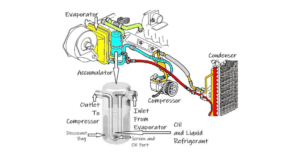 But in reality, the car AC accumulator is one of the most important components in your vehicle’s air conditioning system, especially in systems that use an orifice tube instead of an expansion valve.
If your car’s AC is blowing warm air, cycling strangely, or making odd noises, the accumulator might be the quiet culprit. In this in-depth guide, we’ll cover:
- What a car accumulator is
- How it works
- Signs of a bad accumulator
- Accumulator vs receiver-drier comparison
- Cost of replacement
- Detailed buyer’s guide
- Long technical explanation
- FAQs
Let’s break it.
What Is a Car Accumulator?
A car AC accumulator is a cylindrical container located between the evaporator and the compressor in vehicles that use an orifice tube system. Its primary job is to:
- Store excess refrigerant
- Prevent liquid refrigerant from entering the compressor
- Remove moisture and debris from the AC system
- Ensure only vapor refrigerant returns to the compressor
In short, it protects your compressor and keeps your AC running smoothly. Without it, liquid refrigerant could reach the compressor, and that can destroy it.
How the Car Accumulator Works
The accumulator acts as:
- A temporary storage tank
- A filter
- A moisture remover
Inside the accumulator, you’ll find:
- Desiccant bag (absorbs moisture)
- Filter screen
- Refrigerant inlet and outlet ports
Here’s what happens:
- Refrigerant leaves the evaporator.
- It enters the accumulator.
- Liquid refrigerant settles at the bottom.
- Vapor refrigerant exits toward the compressor.
This ensures the compressor only compresses vapor, not liquid.
Why Liquid Refrigerant Is Dangerous
Compressors are designed to compress gases,s not liquids. Liquid refrigerant is incompressible. If liquid enters the compressor:
- Internal damage occurs
- Valves bend
- Pistons breaThe entirere compressor may fail
The accumulator prevents that scenario.
Car Accumulator vs Receiver-Drier (Comparison Table)
Many people confuse these two components. They are similar but used in different systems.
| Feature | Car Accumulator | Receiver-Drier |
| Used In | Orifice tube systems | Expansion valve (TXV) systems |
| Location | Between evaporator & compressor | Between the condenser & expansion valve |
| Main Function | Prevent liquid refrigerant from entering the compressor | Store and dry high-pressure liquid refrigerant |
| Contains Desiccant | Yes | Yes |
| Protects Compressor | Yes | Indirectly |
| Common in | Many American vehicles | Many European & Asian vehicles |
| Replacement Cost | $200–$500 | $150–$400 |
If your vehicle uses an orifice tube, it likely has an accumulator instead of a receiver-drier.
Symptoms of a Bad Car Accumulator
Here are the most common warning signs:
1. AC Blowing Warm Air
If the desiccant becomes saturated or the unit clogs, refrigerant flow suffers. Result:
- Reduced cooling
- Warm air from vents
2. Strange AC Noises
You might hear:
- Rattling
- Hissing
- Gurgling
Internal damage or loose desiccant can cause this.
3. Moisture in AC System
If moisture isn’t removed properly:
- Ice forms in lines
- Corrosion develops
- AC performance drops
4. Visible Refrigerant Leaks
Oil residue around the accumulator indicates leakage.
5. Compressor Failure
A failing accumulator can allow liquid refrigerant into the compressor. That can lead to:
- Expensive compressor damage
- Metal debris in the system
Personal Experience: Why It Matters
I once ignored weak cooling in my older sedan, assuming it just needed a recharge. A few months later, the compressor failed. The mechanic showed me the old accumulator; the desiccant had broken apart and contaminated the system.
Replacing the compressor and flushing the system cost over $1,200. Had I replaced the accumulator earlier? It would’ve been under $400. Lesson learned.
How Long Does a Car Accumulator Last?
Typically:
- 8–12 years
- 80,000–150,000 miles
But lifespan depends on:
- Climate
- AC usage
- System contamination
- Maintenance habits
When Should You Replace the Accumulator?
Most mechanics recommend replacing it when:
- Replacing the compressor
- Opening the AC system
- After major AC repairs
- Moisture contamination is detected
It’s cheap insurance compared to compressor failure.
Replacement Cost Breakdown
| Service | Average Cost |
| Accumulator Part Only | $40–$150 |
| Labor | $150–$350 |
| Total Replacement | $200–$500 |
| With Compressor Replacement | $800–$2,000 |
Prices vary depending on vehicle make and location.
Buyer’s Guide: Choosing the Right Car Accumulator
If you’re replacing yours, here’s what to look for:
1. OEM vs Aftermarket
OEM (Original Equipment Manufacturer):
- Perfect fit
- Higher reliability
- More expensive
Aftermarket:
- Lower cost
- Quality varies
- Choose trusted brands
For daily drivers, OEM or reputable aftermarket brands are safest.
2. Desiccant Quality
The desiccant absorbs moisture. Look for:
- High moisture absorption capacity
- Durable containment bag
- Corrosion-resistant interior
Cheap units may fail prematurely.
3. Fitment Accuracy
Always verify:
- Year
- Make
- Model
- Engine size
Incorrect fitment can cause a pressure imbalance.
4. Material Quality
Choose:
- Aluminum housing
- Corrosion-resistant finish
- Solid welds
5. Warranty
Look for a 1–2 year warranty minimum.
Deep Technical Explanation (For Those Who Want More)
Internal Structure
Inside the accumulator:
- The inlet tube directs the refrigerant downward
- Liquid settles
- Vapor rises
- Oil returns to the compressor through a calibrated orifice
It also manages oil return to maintain compressor lubrication.
Role in System Efficiency
A properly functioning accumulator:
- Stabilizes pressure
- Prevents compressor slugging
- Maintains oil circulation
- Improves cooling consistency
A bad one:
- Allows moisture buildup
- Causes acid formation
- Leads to internal corrosion
Accumulator and Refrigerant Types
Modern systems may use:
- R-134a
- R-1234yf
Ensure compatibility when replacing.
Preventive Maintenance Tips
To extend accumulator life:
- Run AC monthly
- Fix leaks quickly
- Avoid overcharging refrigerant
- Replace the cabin air filter regularly
- Vacuum the system properly before recharge
Can You Drive With a Bad Accumulator?
Yes, but you shouldn’t for long. Risk includes:
- Compressor damage
- Moisture contamination
- Expensive repairs later
Read More: What Is A Gasket In A Car
FAQs: What Is A Car Accumulator
1. What does a car accumulator do?
It prevents liquid refrigerant from entering the compressor and removes moisture from the AC system.
2. Is the accumulator the same as a receiver-drier?
No. They are used in different AC system designs.
3. How do I know if my accumulator is bad?
Warm air, strange noises, leaks, or compressor issues.
4. Can I replace it myself?
Not easily. The AC system must be evacuated and recharged professionally.
5. Should I replace the accumulator with a compressor?
Yes. It’s strongly recommended.
6. How much does it cost?
Typically $200–$500.
7. Does it improve cooling?
Yes, if the old one was failing.
8. Can moisture damage the AC system?
Absolutely. It causes corrosion and acid formation.
9. How long does replacement take?
1–3 hours typically.
10. Is it necessary after AC flush?
Yes, if contamination was present.
Final Thoughts
The car accumulator may not be the most glamorous part of your vehicle, but it plays a crucial role in protecting your compressor and ensuring consistent cooling performance.
Ignoring it can turn a small repair into a major AC system overhaul. If your AC isn’t performing like it used to, don’t overlook this small but mighty component.