If you’ve ever turned on your car’s air conditioner on a scorching summer afternoon and felt nothing but warm air, you already know how important your AC system really is.
I used to think car air conditioning was simple: press a button, get cold air. But after dealing with a failed compressor (and a surprisingly expensive repair bill), I decided to learn how the system actually works.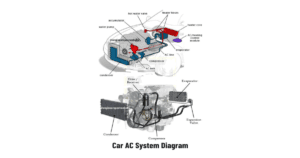 That’s when I realized something important: Your car’s AC system is a carefully engineered loop of multiple components working together,r and if just one part fails, the entire system struggles.
In this guide, I’ll walk you through a full car AC parts diagram explanation, break down each component in simple language, compare major parts, include a buyer’s guide, cost insights, maintenance advice, and answer the most common FAQs.
Let’s break it down.
Car AC Parts Diagram (Simplified Layout)
Here’s how the airflow and refrigerant flow typically move through the system:
- Compressor
- Condenser
- Receiver/Drier or Accumulator
- Expansion Valve or Orifice Tube
- Evaporator Core
- Blower Motor
- Cabin Air Filter
- AC Lines & Hoses
- Pressure Switches & Sensors
These components form a closed-loop refrigeration system very similar to your home AC, just compact and belt-driven.
Major Car AC Components Explained?
1. AC Compressor – The Heart of the System
The compressor is powered by your engine via a serpentine belt. It compresses refrigerant gas and pushes it through the system. Without it? No cooling. When mine failed, I noticed:
- Loud clicking noise
- AC blowing warm air
- Engine strain when AC engaged
Common Issues:
- Clutch failure
- The internis al seizure
- Refrigerant leaks
2. Condthe ensis er – The Heat Releaser
Located at the front of the car (near the radiator), the condenser cools down the hot compressed refrigerant. Think of it as a heat exchanger.
If it gets blocked by dirt or debris, your AC efficiency drops dramatically.
3. Receiver/Drier or Accumulator
This component:
- Removes moisture
- Filters contaminants
- Stores excess refrigerant
Moisture inside an AC system is extremely damaging. This part protects everything else.
4. Expansion Valve (TXV) or Orifice Tube
This small but crucial part controls refrigerant flow into the evaporator.
Too much refrigerant = system overload
Too little = poor cooling
This part balances everything.
5. Evaporator Core – Where Cooling Happens
Located inside the dashboard. When refrigerant reaches the evaporator, it:
- Expands
- Absorbs heat from cabin air
- Produces cold air
If your AC smells musty, the evaporator might be dirty or moldy.
6. Blower Motor
Pushes air through the evaporator and into your cabin. If your AC is cold but the airflow is weak, the blower motor could be failing.
7. Cabin Air Filter
Often overlooked. A clogged filter:
- Reduces airflow
- Causes musty smell
- Makes AC feel weak
I now replace mine every 12 months; it makes a noticeable difference.
Comparison Table – Major Car AC Parts
| Component | Main Function | Average Replacement Cost | Common Failure Signs | Difficulty Level |
| Compressor | Compresses refrigerant | $500–$1,200 | Warm air, noise | High |
| Condenser | Releases heat | $300–$800 | Overheating, weak cooling | Medium |
| Evaporator | Absorbs cabin heat | $600–$1,500 | Musty smell, leaks | Very High |
| Expansion Valve | Controls refrigerant flow | $200–$500 | Inconsistent cooling | Medium |
| Blower Motor | Circulates air | $250–$600 | Weak airflow | Low–Medium |
| Cabin Air Filter | Filters air | $20–$80 | Poor airflow | Very Easy |
How the Car AC System Works (Step-by-Step)
Let’s simplify the refrigeration cycle:
- Compressor pressurizes refrigerant gas.
- Condenser cools it into liquid.
- ReceiverDrr. The compressors’ moisture.
- The expansion valve loThe condensersure.
- The evaporator absorbs cabin heat.
- Blower pushes cold air inside.
- Refrigerant returns to compressor.
It’s a continuous blower.
Signs Your Car AC Parts May Be Failing
- AC blowthe s warm air
- Unusual clicking or grinding noise
- MuCar’s smell
- Water is leaking inside the cabin
- Weak airflow
- AC works only while driving
Each symptom points to a different part in the diagram.
Buyer’s Guide: Choosing Car AC Parts
If you’re replacing a component, here’s what I learned the hard way.
1. OEM vs Aftermarket
OEM:
- Exact fit
- Reliable
- More expensive
Aftermarket:
- Budget-friendly
- Quality varies
- Choose trusted brands
If replacing a compressor, I recommend OEM or premium aftermarket only.
2. Always Replace Supporting Parts
When replacing:
- Compressor → Replace receiver/drier too
- System opened → Replace seals and O-rings
- Major repair → Flush system
Skipping this can cause repeat failure.
3. Refrigerant Compatibility
Older cars use R134a. Newer vehicles use R1234yf. Never mix refrigerants.
4. Labor Costs Matter
Evaporator replacement is expensive mainly because:
- Dashboard removal required
- 6–10 hours labor
Sometimes labor costs more than parts.
Maintenance Tips to Extend AC Life
- Runof AC weekly (even in winter)
- Replace cabin air filter yearly
- Keep condenser clean
- Fix refrigerant leaks early
- Don’t ignothe re strange noises
I learned that the hat replacement is much cheaper than repair.
Estimated Full System Replacement Cost
Full AC rebuild can cost:
$1,500 – $3,500+
That’s why early diagnosis matters.
Advanced Technical Breakdown (For Enthusiasts)
The AC system operates under two pressure sides:
High Pressure Side:
- Compressor output
- Condenser
- Liquid line
Low Pressure Side:
- Expansion valve
- Evaporator
- Suction line
Pressure sensors monitor the system balance. If readings are abnormal, the system shuts off to prevent damage.
Common Myths About Car AC Systems
Myth: AC uses more fuel than open windows
Truth: At highway speed, open windows increase drag.
Myth: Refrigerant never needs replacement
Truth: Small leaks are common over time.
Myth: Recharging fixes everything
Truth: If there’s a leak, recharge is temporary.
Real-World Personal Review Experience
When my compressor failed, I ignored weak cooling for months.
Result:
- Compressor seized
- Metal debris contaminated system
- Full system flush required
Final bill: $1,900
If I had fixed it earlier, it would’ve cost around $600.
Lesson learned: Don’t ignore early warning signs.
Read More: What Is An AC Belt In A Car
FAQs: Car AC Parts Diagram
1. What is the most important part of a car’s AC system?
The compressor, without it, refrigerant doesn’t circulate.
2. Why is my AC blowing warm air?
Possible causes:
- Low refrigerant
- Failed compressor
- Clogged condenser
- Faulty expansion valve
3. How long do car AC compressors last?
Typically 8–12 years, depending on usage.
4. Can I drive with a bad AC compressor?
Yes, but if it seizes, it can damage the belt system.
5. Why does my car’s AC smell bad?
Dirty evaporator or old cabin air filter.
6. How often should I recharge refrigerant?
Only if low, it’s a sealed system.
7. Why does AC work while driving but not idling?
Weak cooling fan or condenser airflow issue.
8. Is AC repair expensive?
Minor repairs: $150–$500
Major repairs: $1,000+
Final Thoughts
Understanding the car AC parts diagram gives you power,r not just knowledge. When you know:
- What each component does
- How they interact
- Signs of failure
- Replacement costs
You make smarter repair decisions. Your car’s AC isnmagict it’st’s engineering. And once you understand the diagram, everything makes sense.