There’s nothing worse than turning on your car’s AC on a hot day and getting warm air instead of a refreshing blast of cold air. I’ve been there, stuck in traffic, sweating, wondering if the entire AC system was about to cost me a fortune.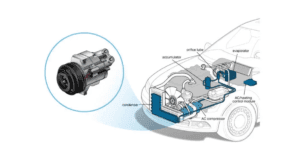 In many cases, the issue points back to one critical component: the car AC compressor. The AC compressor is essentially the heart of your vehicle’s air conditioning system.
Without it, refrigerant doesn’t circulate, pressure isn’t maintained, and cooling simply doesn’t happen. In this complete guide, I’ll walk you through:
- How to test a car AC compressor step-by-step
- Signs of a bad AC compressor
- Electrical and mechanical testing methods
- A comparison table of testing methods
- A buyer’s guide for replacement compressors
- Deep troubleshooting explanations
- Frequently asked questions
Let’s dive in.
What Does a Car AC Compressor Do?
The AC compressor pressurizes and circulates refrigerant through your vehicle’s air conditioning system. It works alongside:
- AC condenser
- Expansion valve/orifice tube
- Evaporator
- Receiverdryerr or accumulator
When the compressor fails, your entire cooling system struggles or stops completely.
Symptoms of a Bad Car AC Compressor
Before testing, look for these warning signs:
1. Warm Air From Vents
The most common symptom. If the AC is blowing warm or slightly cool air, your compressor may not be engaging properly.
2. Loud Noises
Grinding, rattling, or squealing sounds when the AC is on often indicate internal compressor damage.
3. AC Clutch Not Engaging
If the clutch doesn’t click when AC is turned on, there may be an electrical or mechanical failure.
4. Refrigerant Leaks
Oil stains around the compressor housing can indicate seal failure.
5. Circuit Breaker/Fuse Blowing
Electrical overload can point to compressor clutch coil issues.
Tools You’ll Need to Test a Car AC Compressor
To properly diagnose the issue, you may need:
- Digital multimeter
- AC manifold gauge set
- Test light
- Basic socket set
- Safety gloves and goggles
Step-By-Step: How To Test Car AC Compressor
Let’s go through this carefully.
Step 1: Visual Inspection
Start simple.
✔ Look for oil stains
✔ Check wiring connections
✔ Inspect compressor clutch
✔ Look for broken belts
If the serpentine belt is damaged, the compressor won’t spin.
Step 2: Check AC Clutch Engagement
- Start engine
- Turn AC to max
- Observe the compressor pulley
You should see the clutch plate engage and spin with the pulley. If it doesn’t engage:
- Check the AC fuse
- Check relay
- Test clutch coil
Step 3: Test Compressor Clutch With Multimeter
- Turn off the engine
- Disconnect the clutch connector
- Set the multimeter to ohms
- Measure resistance
Typical reading: 3–5 ohms (varies by vehicle)
If reading shows:
- OL (open loop) → Burned coil
- 0 ohms → Short circuit
Either means replacement likely needed.
Steis p 4: Check Power Supply
With AC on:
- Test voltage at compressor connector
- You should see around 12 volts
If no voltage:
- Check the AC relay
- Check pressure switches
- Check wiring harness
Step 5: Check Refrigerant Pressure (Manifold Gauges)
Attach gauges to:
- Low-pressure port
- High-pressure port
Expected readings (engine running):
| Side | Normal Range |
| Low Side | 25–45 PSI |
| High Side | 200–250 PSI |
If low side is high and the high side is low → the compressor may not be pumping.
Comparison Table: AC Compressor Testing Methods
| Testing Method | Difficulty | Tools Required | What It Checks | Best For |
| Visual Inspection | Easy | None | Physical damage | Quick diagnosis |
| Clutch Engagement Test | Easy | None | Mechanical activation | Beginners |
| Multimeter Test | Moderate | Multimeter | Electrical integrity | DIYers |
| Manifold Gauge Test | Advanced | Gauge Set | Refrigerant pressure | Accurate diagnosis |
| Professional Scan Tool | Advanced | OBD Scanner | ECU-related issues | Modern vehicles |
Common AC Compressor Problems Explained
1. Clutch Failure
Often caused by coil burnout or worn friction plates.
2. Internal Seizure
Caused by a lack of lubrication or debris contamination.
3. Refrigerant Contamination
Dirty refrigerant can destroy internal components.
4. Pressure Switch Malfunction
Compressor won’t acThe compressorpressure readings are unsafe.
Can You Drive With a Bad AC Compressor?
Technically yes, but:
- Seized compressor, cA seizedage serpentine belt
- Debts can contaminate entire AC system
- Inthe creased fuel consumption
I always recommend diagnosing early to avoid expensive repairs.
When To Replace vs Repair
| Condition | Repair | Replace |
| Bad clutch only | ✔ Yes | No |
| Seized compressor | No | ✔ Yes |
| Electrical coil issue | ✔ Sometimes | Maybe |
| Internal contamination | No | ✔ Yes |
Buyer’s Guide: Choosing a Replacement AC Compressor
If testing confirms failure, here’s how to choose the right replacement.
1. OEM vs Aftermarket
OEM:
- Exact fit
- Higher cost
- Reliable
Aftermarket:
- Cheaper
- Quality varies
2. New vs Remanufactured
New:
- Longer lifespan
- Higher cost
Remanufactured:
- Budget-friendly
- Must ensure reputable suppliers
3. Compatibility
Always check:
- Engine type
- VIN number
- RefrigeVIN(R134a or R1234yf)
4. Warranty
Look for at least 12-month warranty.
5. Complete Kit
Some compressors include:
- Clutch
- Oil
- Seals
- Drier
This can save installation hassle.
My Personal Recommendation
From experience, if your compressor has internal damage, don’t try to rebuild it cheaply. Replace the compressor and flush the system. Also replace:
- Receiver/drier
- Expansion valdryeripping these can cause repeat failure.
Long Expansion: Deep Dive Into AC Compressor Testing (Advanced Explanation)
To truly understand compressor testing, you must understand pressure dynamics. When functioning properly:
- Compressor compressA compressorssure vapor.
- Sends high-pressure gas to condenser.
- Condensethe r cools it into liquid.
- Expansion va alve redThe expansionsure.
- The evaporator absorbs.
The evaporatorompression isn’t happening, pressure equalizes. This is why manifold readings are so important. Electrical failures usually prevent clutch engagement.
Mechanical failures allow engagement but no pressure change. Testing both systems ensures accurate diagnoses. Modern vehicles also rely on:
- PCM control
- Pressure sensors
- CAN communication
Some compressors are variable displacement and don’t use traditional clutch systems. For those, scan tool diagnostics become essential.
Preventing Future Compressor Failure
- Run AC weekly (even in winter)
- Replace cabin air filter
- Avoid overcharging refrigerant
- Fix leaks immediately
- Use correct oil type
Read More: What Are Car Rotors
FAQs: How To Test a Car AC Compressor
1. Can I teach the AC compressor without the gauges?
Yes, but pressure testing gives the most accurate results.
2. What happens if the compressor clutch doesn’t engage?
Likely an electrical issue or low refrigerant.
3. How much does an AC can ompressor replaan cement cost?
Typically $500–$1,200 depending on vehicle.
4. Can low refrigerant damage compressor?
It reduces lubrication.
5. How long does AC compressor last? an
Usually 8–12 years.
6. Can I replace only the clutch?
In some vehicles, yes.
7. Why is my AC compressor noisy?
Internal bearing or piston damage.
8. Is AC compressor repair worth it?
Usually replacement is bet,ter long-term.
9. What PSI should low side be?
25–45the PSI when running.
10. Does AC the compressor affaffect thegine?
Yes, it addthe s load when engaged.
Final Thoughts
Testing a car’s AC compressor is as intimidating as it sounds. With a multimeter, manifold gauge set, and careful observation, you can confidently diagnose whether your compressor is working or failing. The key is systematic testing:
- Visual inspection
- Clutch engagement
- Electrical testing
- Pressure testing
If done correctly, you’ll avoid unnecessary replacement costs and make informed repair decisions. Your AC compressor is the heart of your cooling system. Take care of it, and it will keep you comfortable for years.