If you’ve ever seen your check engine light turn on and felt that slight panic, there’s a good chance your O2 sensor might be involved. I remember the first time it happened to me. The car felt fine. No strange noise.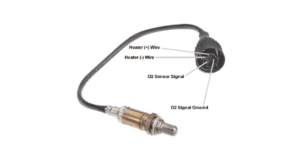 No smoke. But the dashboard light stayed on. After a quick scan, the culprit was a faulty oxygen sensor. At first, I thought, “It’s just a small sensor, how important can it be?” Very important.
Let’s break it.
What Is An O2 Sensor In A Car?
An O2 sensor (oxygen sensor) measures the amount of oxygen in your car’s exhaust gases. Its job is to help the engine:
- Adjust the air-fuel mixture
- Improve fuel efficiency
- Reduce harmful emissions
- Maintain smooth engine performance
Modern vehicles, whether it’s a Toyota Corolla or a Ford F-150, rely heavily on O2 sensors for proper operation.
Without it, your engine wouldn’t know if it’s running too rich (too much fuel) or too lean (too much air).
Why Is It Called an Oxygen Sensor?
Because it measures oxygen levels in the exhaust system. After fuel burns in the engine, exhaust gases pass through the exhaust manifold. The O2 sensor reads oxygen content and sends data to the Engine Control Unit (ECU).
The ECU then adjusts fuel injection accordingly. It’s basically a feedback system.
Where Is The O2 Sensor Located?
Most vehicles have:
- One sensor before the catalytic converter (upstream)
- One sensor after the catalytic converter (downstream)
Cars built after 1996 (OBD-II standard) usually have multiple O2 sensors. Manufacturers like Honda and Chevrolet commonly use 2–4 sensors depending on engine configuration.
How Does An O2 Sensor Work? (Simple Explanation)
Think of it like a thermostat, but for fuel mixture.
It Detects:
- Oxygen level in exhaust
It Sends:
- Voltage signal to ECU
ECU Adjusts:
- Fuel injection timing
- Air-fuel ratio
If too much oxygen is detected → engine is running lean → ECU adds more fuel.
If too little oxygen is detected → engine is running rich → ECU reduces fuel.
Types of O2 Sensors (Comparison Table)
Not all O2 sensors are the same.
| Type | Used In | Accuracy | Response Time | Cost | Best For |
| Narrowband O2 Sensor | Older vehicles | Moderate | Slower | Low | Basic engines |
| Wideband O2 Sensor | Modern cars | High | Fast | Higher | Performance & efficiency |
| Heated O2 Sensor (HO2S) | Most modern cars | High | Fast warm-up | Medium | Cold climates |
| Titania O2 Sensor | Some imports | Moderate | Fast | Medium | Specific applications |
Most modern vehicles from BMW and Nissan use heated or wideband sensors.
Symptoms of a Bad O2 Sensor
This is where most people notice something wrong. Common signs include:
- Check the engine light on
- Poor fuel economy
- Rough idling
- Engine misfires
- Black smoke from the exhaust
- Failed emissions test
When mine failed, fuel mileage dropped almost 20%.
What Happens If You Ignore a Bad O2 Sensor?
Ignoring it can lead to:
- Damaged catalytic converter
- Poor performance
- Increased fuel costs
- Higher emissions
Replacing a sensor might cost $100–$300.
Replacing a catalytic converter?
$1,000–$2,500+.
Big difference.
How Long Do O2 Sensors Last?
Typical lifespan:
- 60,000 to 100,000 miles
Some high-quality sensors from brands like Bosch and Denso may last longer.
How Much Does O2 Sensor Replacement Cost?
Average total cost:
- Sensor: $50–$200
- Labor: $80–$200
- Total: $150–$400
Luxury vehicles like Mercedes-Benz may cost more.
Can You Drive With a Bad O2 Sensor?
Yes, but you shouldn’t for long. Short-term driving may not cause immediate failure. Long-term damage is very possible. Fuel economy will drop significantly.
How To Test An O2 Sensor
You can test it using:
- OBD-II scanner
- Multimeter
- Oscilloscope (advanced method)
A fluctuating voltage between 0.1V and 0.9V usually indicates a working sensor (for narrowband types).
Buyer’s Guide: Choosing the Right O2 Sensor
If you’re replacing one, here’s what matters.
1. Check Vehicle Compatibility
Match:
- Year
- Make
- Model
- Engine size
2. OEM vs Aftermarket
OEM (Original Equipment Manufacturer):
- More reliable
- Exact fit
- Higher price
Aftermarket:
- Cheaper
- May vary in quality
Brands like ACDelco offer reliable OEM-style replacements.
3. Sensor Type
Know if your vehicle requires:
- Narrowband
- Wideband
- Heated sensor
4. Connector Type
Some are:
- Direct-fit (plug and play)
- Universal requires wiring)
Direct-fit is safer for beginners.
My Personal Experience With O2 Sensor Replacement
I once replaced a downstream sensor myself. It took:
- 30 minutes
- Basic wrench
- O2 sensor socket
The hardest part? Loosening a rusted sensor. After replacement:
- Check engine light cleared
- Fuel economy improved
- Idle became smoother
Worth it.
Why O2 Sensors Matter for Emissions
O2 sensors help reduce pollutants like:
- Carbon monoxide
- Nitrogen oxides
- Hydrocarbons
They work closely with the catalytic converter to keep emissions low. Without a functioning O2 sensor, emissions skyrocket.
O2 Sensor vs Catalytic Converter (Quick Comparison)
| Component | Function | Cost | Failure Impact |
| O2 Sensor | Monitors oxygen levels | Low–Medium | Fuel inefficiency |
| Catalytic Converter | Reduces exhaust pollutants | High | Major emissions failure |
The sensor protects the converter.
Read More: How Much Are Car Rotors
FAQs: What Is An O2 Sensor In A Car
1. What doethe s O2 sensor stand for?
Oxygen sensor.
2. How many O2 sensors does a car have?
Most modern cars have 2–4 sensors.
3. Can a bad O2 sensor cause a rough idle?
Yes.
4. Will a bad O2 sensor cause a misfire?
Indirectly, yes.
5. Can I replace the O2 sensor myself?
Yes, if you have basic tools.
6. Does the O2 sensor affect fuel mileage?
Absolutely.
7. How do I know which O2 sensor is bad?
Use an OBD-II scanner to check fault codes.
8. Is it expensive to fix?
Usually not, compared to other engine components.
Final Thoughts
An O2 sensor may look small, but it plays a massive role in:
- Fuel efficiency
- Engine performance
- Emissions control
- Long-term engine health
Ignoring it can cost you more later. Maintaining it saves money. If your check engine light is on, don’t panic. Scan it first. It might just be a simple oxygen sensor replacement.