If you’ve been digging around your car’s systems and came across the term “accumulator,” you’re probably wondering: Where exactly is it located?
Here’s the truth from real-world experience: there isn’t just one accumulator in a car, and its location depends entirely on which system you’re talking about.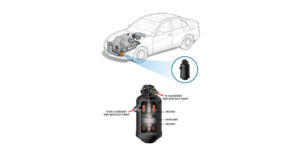 Most commonly, people mean the A/C accumulator, but accumulators can also exist in braking systems, hydraulic suspensions, and transmissions.
In this guide, I’ll walk you through each type in a clear, practical way just like I would if we were standing next to your car with the hood open.
Quick Answer (Straight to the Point)
The most common accumulator (A/C system) is usually located:
👉 Between the evaporator outlet and the compressor (on the low-pressure side)
👉 Typically found near the firewall or passenger side of the engine bay
What Is an Accumulator in a Car?
An accumulator is basically a storage and filtering unit used in different systems. Its job can include:
- Storing fluid or pressure
- Filtering debris
- Preventing damage to key components
- Ensuring smooth system operation
Think of it as a buffer or safety tank inside your car.
Types of Accumulators and Their Locations
1. A/C Accumulator (Most Common)
This is what most drivers are referring to.
Location:
- Inside the engine bay
- Near the firewall (back of engine compartment)
- On the low-pressure line between the evaporator and compressor
Visual clues:
- Aluminum canister shape
- Connected to A/C lines
- Often near passenger side
💡 Real-world tip: If your car has an orifice tube system, it will have an accumulator. If it uses an expansion valve, it uses a receiver-drier instead.
2. Brake Accumulator (ABS Systems)
Found in vehicles with advanced braking systems.
Location:
- Near the ABS module
- Typically in the engine bay
- Sometimes mounted on or near the brake master cylinder
Function:
- Stores hydraulic pressure
- Assists braking performance during emergencies
3. Hydraulic Suspension Accumulator
Mostly found in luxury or specialized vehicles.
Location:
- Near suspension components
- Under the car or near wheel assemblies
Function:
- Maintains pressure for smoother ride quality
4. Transmission Accumulator
Used in automatic transmissions.
Location:
- Inside or attached to the transmission housing
Function:
- Controls shift smoothness
- Reduces harsh gear changes
Comparison Table: Accumulator Types & Locations
| Accumulator Type | Location | Function | Common In |
| A/C Accumulator | Engine bay (near firewall) | Filters & stores refrigerant | Most modern cars |
| Brake Accumulator | Near ABS module | Stores brake pressure | Cars with ABS |
| Suspension Accumulator | Near suspension system | Smooths ride | Luxury vehicles |
| Transmission Accumulator | Inside transmission | Controls gear shifts | Automatic cars |
My Personal Experience (What You’ll Actually See)
In most everyday cars, the only accumulator you’ll realistically interact with is the A/C accumulator.
I remember trying to find one for the first time. I expected something obvious, but it blended in with other components. The trick is knowing what to look for:
- A small metal cylinder
- Connected to A/C pipes
- Positioned closer to the cabin side (firewall)
Once you spot it, you’ll never miss it again.
How to Identify the A/C Accumulator Step-by-Step
Step 1: Open the Hood
Look toward the back of the engine bay.
Step 2: Find the Firewall
That’s the metal wall separating engine and cabin.
Step 3: Locate A/C Lines
Follow the aluminum pipes.
Step 4: Spot the Canister
You’ll find a cylindrical container that’s your accumulator.
Common Signs of a Faulty Accumulator
If your accumulator is failing, your car will usually give hints:
- Weak or inconsistent A/C cooling
- Moisture contamination in system
- Unusual noises from A/C compressor
- Visible corrosion or leaks
Buyer’s Guide: Choosing the Right Accumulator
If you’re planning to replace one, here’s how to avoid mistakes:
1. Match Your Vehicle Exactly
- Year, make, and model matter
- Even engine variants can differ
2. Check System Type
- Orifice tube system → needs accumulator
- Expansion valve system → uses receiver-drier
3. Material Quality
Look for:
- Corrosion-resistant aluminum
- High-quality desiccant inside
4. Brand Reliability
A good accumulator should:
- Handle pressure well
- Last several years without leaks
5. Replace Alongside Other Components
Best practice:
- Replace accumulator when changing compressor
- Prevent contamination issues
Comparison Table: Accumulator vs Receiver-Drier
| Feature | Accumulator | Receiver-Drier |
| Used In | Orifice tube systems | Expansion valve systems |
| Location | Low-pressure side | High-pressure side |
| Main Function | Protect compressor | Remove moisture |
| Shape | Cylindrical | Smaller canister |
Long Detailed Guide (Deep Dive)
Why Location Matters
Knowing where the accumulator sits helps with:
- Diagnosing A/C issues
- Performing repairs
- Avoiding unnecessary part replacements
How It Works (A/C Example)
In the A/C system:
- Refrigerant leaves evaporator
- Enters accumulator
- Moisture and debris are filtered
- Clean refrigerant goes to compressor
This prevents compressor damage, one of the most expensive A/C components.
Why Cars Even Need Accumulators
Without an accumulator:
- Liquid refrigerant could enter compressor
- Internal damage would occur
- System lifespan would decrease
So while it’s small, it plays a critical protective role.
Can You Drive Without One?
No, at least not safely in terms of system health. Removing or bypassing an accumulator:
- Risks compressor failure
- Leads to inefficient cooling
- Causes long-term damage
Replacement Difficulty
- A/C accumulator: Moderate difficulty
- Brake accumulator: Advanced (professional recommended)
- Transmission accumulator: Complex (inside transmission)
Read More: Is It Illegal To Not Have A Rear View Mirror
Cost Expectations
| Component Type | Cost Range (Approx.) |
| A/C accumulator | Low to moderate |
| Brake accumulator | Moderate to high |
| Suspension type | High |
| Transmission type | High |
FAQs: Where Is The Accumulator Located In A Car
1. Is the accumulator always in the same place?
No, it depends on the system and vehicle design.
2. How do I know if my car has one?
Most cars with orifice tube A/C systems have an accumulator.
3. Can I replace it myself?
Yes for A/C accumulators, but you’ll need proper tools and safety precautions.
4. What happens if it fails?
You may experience:
- Poor A/C performance
- Compressor damage
- Moisture contamination
5. Is it the same as a receiver-drier?
No, they serve similar purposes but are used in different systems.
6. How long does it last?
Typically 5–10 years, depending on usage and conditions.
Final Thoughts
So, where is the accumulator located in a car? 👉 In most cases, you’ll find the A/C accumulator in the engine bay near the firewall, on the low-pressure side of the system.
From personal experience, once you know what to look for, it becomes easy to spot and understand its role, which helps you avoid costly repairs down the line.
It may be a small component, but it plays a big role in protecting your car’s systems.