If you’ve ever driven in the middle of a hot day with a broken AC, you already know it’s miserable. That’s exactly what happened to me. One afternoon, my car’s AC went from ice-cold to barely blowing cool air.
At first, I thought it was something minor. Maybe low gas, maybe a quick fix. But as I dug deeper, I realized something surprising: A car AC system isn’t just “one thing.” It’s a whole network of components working together.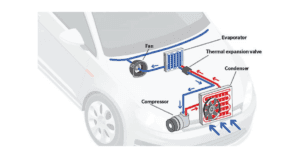 Understanding those parts didn’t just help me fix the issue; it also saved me money and prevented me from getting overcharged.
So if you’re curious about how your car’s AC works or you’re dealing with cooling issues, this guide breaks everything down in a simple, practical way.
The Big Picture: How a Car AC System Works
Before jumping into the parts, let’s simplify the process. Your car’s AC system works by:
- Compressing refrigerant
- Cooling it down
- Expanding it rapidly
- Absorbing heat from inside your car
That’s how hot air turns into cold air. Now let’s break down the key components that make this happen.
Main Parts of a Car AC System
1. Compressor (The Heart of the System)
The compressor is where everything starts.
- Pressurizes refrigerant
- Circulates it through the system
- Powered by the engine via a belt
If this fails, your AC stops working completely.
2. Condenser (Heat Releaser)
Located at the front of your car, near the radiator.
- Converts hot gas into liquid
- Releases heat outside the car
Think of it as the “cooling station” after compression.
3. Evaporator (Cold Air Producer)
This is inside your dashboard.
- Absorbs heat from cabin air
- Produces cool air that blows through vents
This is the part you actually feel working.
4. Expansion Valve / Orifice Tube
This controls how refrigerant flows.
- Reduces the pressure of liquid refrigerant
- Allows it to expand and cool rapidly
It’s small but extremely important.
5. Receiver-Drier / Accumulator
This component acts like a filter and storage unit.
- Removes moisture
- Filters contaminants
- Stores excess refrigerant
Moisture is the enemy of AC systems. This part protects everything.
6. Refrigerant (The Cooling Fluid)
This is the substance that circulates through the system. Common types:
- R134a (older cars)
- R1234yf (newer vehicles)
It’s what actually absorbs and releases heat.
7. Blower Motor & Cabin Filter
These help move air into your cabin.
- The blower motor pushes air
- Cabin filter cleans incoming air
Without these, even cold air wouldn’t reach you properly.
Comparison Table: Key Car AC Components at a Glance
| Component | Function | Location | Common Failure Sign |
| Compressor | Pressurizes refrigerant | Engine bay | No cooling at all |
| Condenser | Releases heat | Front of the car | Weak cooling |
| Evaporator | Absorbs cabin heat | Dashboard | Warm air, bad smell |
| Expansion Valve | Controls refrigerant flow | Near evaporator | Inconsistent cooling |
| Receiver-Drier | Filters moisture & debris | AC line | Reduced efficiency |
| Refrigerant | Transfers heat | Entire system | AC stops cooling |
| Blower Motor | Circulates air | Cabin/dashboard | Weak airflow |
Real-World Insight: What Usually Goes Wrong
From experience (and a few repair bills), here’s what commonly fails:
Most Common Issues:
- Low refrigerant (leaks)
- Compressor failure
- Dirty condenser
- Clogged cabin filter
What I Learned:
Sometimes the problem isn’t expensive; it’s just misdiagnosed. A mechanic once quoted me for a compressor replacement… Turns out I just needed a refrigerant recharge.
Buyer’s Guide: Choosing Car AC Parts (Without Getting Ripped Off)
If you ever need to replace AC components, this section will save you time and money.
1. OEM vs Aftermarket Parts
- OEM (Original Equipment Manufacturer)
- Perfect fit
- More expensive
- Aftermarket
- Cheaper
- Quality varies
Tip: Go OEM for compressors; aftermarket is fine for filters.
2. Refrigerant Type Matters
Always check your car’s specification. Using the wrong refrigerant can:
- Damage the system
- Reduce efficiency
3. Build Quality
Look for:
- Corrosion resistance
- Strong seals
- Brand reputation
Cheap parts often fail quickly.
4. Warranty
Important for expensive parts like compressors.
Look for:
- At least 6–12 months warranty
5. Installation Cost
Some parts are cheap but expensive to install.
Example:
- Evaporator → low part cost, high labor cost
Signs Your Car AC Needs Attention
Watch for these early warnings:
- AC is blowing warm air
- Strange noises
- Bad smell from vents
- Weak airflow
- AC cycles on/off frequently
Catching issues early can save a lot of money.
Long-Term Ownership Experience (Deep Dive)
Over time, I started seeing my car’s AC system differently, not as a mystery, but as a system that just needs basic care.
Maintenance Habits That Helped:
- Running AC regularly (even in winter)
- Cleaning the condenser area
- Replace the cabin filter every 6–12 months
- Checking refrigerant levels
These small habits made a big difference.
Why Understanding AC Parts Actually Matters
Here’s the truth: Most people don’t learn about their car’s AC system until something breaks. And that’s when mistakes happen:
- Overpaying for repairs
- Replacing the wrong parts
- Ignoring simple fixes
A little knowledge goes a long way.
Read More: Rear Car Window Replacement | My Honest Experience
FAQs: What Parts Are In A Car AC System
1. What is the most important part of a car’s AC system?
The compressor powers the entire system.
2. How often should I recharge refrigerant?
Only when needed. If it’s low, there’s likely a leak.
3. Why is my AC blowing hot air?
Common causes:
- Low refrigerant
- Compressor failure
- Electrical issues
4. Can I fix car AC issues myself?
Simple tasks like replacing cabin filters, yes. Major repairs are best left to professionals.
5. How long does a car AC system last?
With proper care, 8–15 years.
6. Why does my AC smell bad?
Usually due to mold in the evaporator or dirty filters.
7. Is it expensive to fix a car’s AC?
It depends:
- Minor fixes: cheap
- Compressor replacement: expensive
Final Thoughts
A car AC system might seem complicated, but once you understand the parts, it all makes sense. And more importantly, it puts you in control.
Whether you’re troubleshooting a problem or just trying to maintain your car better, knowing these components can save you money, time, and frustration.
Because at the end of the day, driving should be comfortable,e and a working AC makes all the difference.